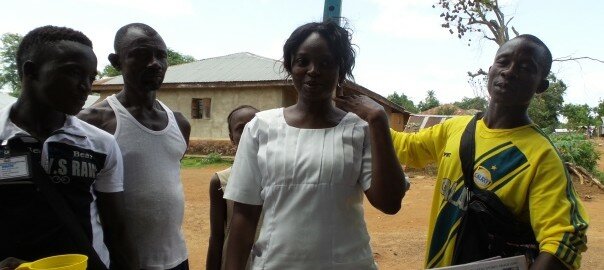
Community health officer Hawa Margai speaks about onchocerciasis to a group of women at the Levuma community health center.
During the month of October, END7 student supporters are celebrating NTD Success Stories from four countries — Haiti, India, Sierra Leone and the Philippines — that have overcome incredible obstacles to make progress towards NTD control and elimination. This week’s success story comes from Sierra Leone, where inspiring efforts are being made to fight NTDs in the wake of the Ebola epidemic.
Six NTDs are found in all 14 health districts in Sierra Leone, threatening nearly the entire population of the country. Sierra Leone faces many health and development challenges, but the government has exerted strong leadership in the fight against NTDs. By 2004, the national NTD program had successfully mapped the prevalence of targeted NTDs nationwide, and in 2005 they launched a mass drug administration (MDA) campaign to treat every at-risk community with the participation of nearly 30,000 volunteer community drug distributors. Supported by the U.S. Agency for International Development (USAID), Sierra Leone’s Ministry of Health had distributed more than 57 million NTD treatments nationwide by the beginning of 2014. As a result of these efforts, the country was on track to begin the World Health Organization process of verifying the elimination of lymphatic filariasis (LF) in eight of 14 health districts in 2014. Unfortunately, when the West African Ebola epidemic reached Sierra Leone in May of that year, all public health program activities were suspended as the country raced to stop the spread of Ebola. As a result, the Sierra Leone NTD Program was unable to carry out MDA in 2014, interrupting progress towards LF elimination.
But today, the government of Sierra Leone and partner organizations are working hard make up for lost time. In May of 2015, on the heels of nationwide malaria and vaccination campaigns, MDA restarted in Sierra Leone. Just this month, from October ninth to 13th, the Ministry of Health’s NTD Program, through the District Health Management Team, ran an MDA campaign targeting 1.4 million people with drugs for LF and soil-transmitted helminths (STH).
The relaunch of MDA this year required careful preparation, including refresher training session for community drug distributors and program administrators. Extensive social mobilization campaigns, aimed at educating communities still reeling from the Ebola epidemic about the importance of participating in MDA, were conducted through community meetings and radio spots. As a result of this careful preparation, early indications are that Sierra Leone’s 2015 MDAs have been successful.
The consistent key to Sierra Leone’s inspiring success tackling NTDs before and after the Ebola epidemic has been the leadership and commitment of volunteer community drug distributors. Elected by their communities, these volunteers reach the most remote corners of the country, enabling Sierra Leone to consistently achieve treatment coverage above 75 percent in targeted communities.
Given Sierra Leone’s small geographic size, the strong political support of the government and the commitment of the volunteer community drug distributors who form the backbone of MDA programs, the country is in the unique position to become one of the first countries in Africa to control snail fever and intestinal worms and eliminate river blindness and elephantiasis. Sierra Leone’s NTD program has also successfully demonstrated that MDA can be achieved in highly populated urban settings. But additional support is needed. By integrating NTD treatment with schools and other health programs, millions of people at risk for NTDs can live free of these diseases of poverty and their devastating effects including malnutrition, disability, social stigmatization and a loss of productivity.
Sierra Leone’s progress against NTDs despite the challenges posed by the Ebola epidemic should inspire other countries to redouble their efforts to address these diseases. Now more than ever, support for robust public health efforts like Sierra Leone’s NTD Program is needed to build on this impressive progress. END7 supporters are eager to celebrate Sierra Leone’s progress and look forward to celebrating more milestones as the country moves closer to its ultimate goal of controlling and eliminating NTDs.